
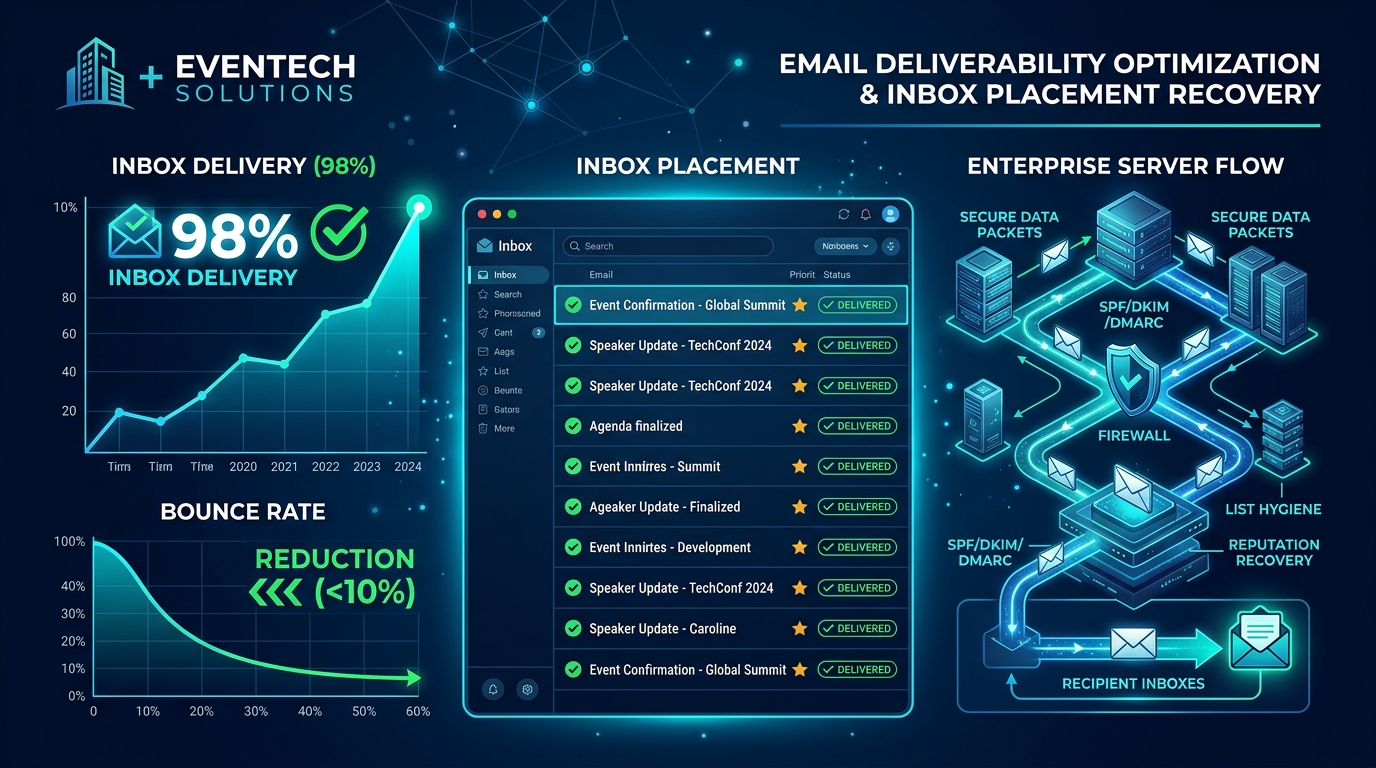
How we rebuilt a fragmented email infrastructure to improve deliverability, reduce bounce rates, and create a scalable foundation for customer communications, achieving 98% inbox delivery and under 10% bounce rate.
The Challenge: An existing platform, but emails that weren't engaging their audience
For many businesses, email is far more than another customer touchpoint. It is a critical communication channel for delivering notifications, supporting customer onboarding, sharing important updates, and nurturing business relationships.
When emails fail to reach their intended recipients, the consequences extend beyond marketing performance. Customers can miss important information, communications lose their impact, and opportunities to build lasting relationships can be lost.
As mailbox providers continually refine their anti-spam controls and sender requirements, maintaining reliable email delivery requires an ongoing, progressive deliverability strategy.
For this growing B2B events and corporate conferences organisation, email performance had become a significant challenge. The business had invested heavily in its platform. Notifications were being sent, marketing campaigns were underway, and the team was actively communicating with its target audience. Yet engagement remained extremely low.
Initially, the team questioned whether the emails themselves were the problem. That was when they approached The Code & Clicks UK's team of experts. Our review revealed that the issue went beyond content and campaign execution.
Over time, the business added multiple email systems and applications, creating a fragmented infrastructure that was increasingly difficult to manage.
What we found
A deeper technical review uncovered several issues:
- Legacy DNS records
- Duplicate SPF entries
- Inconsistent DKIM configuration
- Missing DMARC enforcement
- Multiple applications sending from the same domain
- A custom-built notification service with inconsistent authentication
- No defined sender reputation strategy
- No structured mailbox warm-up process
Simply put, every new system or configuration change had added another layer of complexity. This business wasn't short on effort; its email ecosystem needed a more coordinated approach to support projected results.
Our Objective: Ensuring the right emails reached the right people
After reviewing the whole setup, we realised our goal wasn't simply to increase the number of emails being sent. It was to build an email environment that could:
- Improve inbox placement
- Reduce bounced and undelivered emails
- Establish greater trust with mailbox providers
- Improve the reliability of transactional communications
- Support marketing campaigns more effectively
- Create a scalable email foundation for future growth
- Give the business greater control over its email ecosystem
There was also a more practical, unspoken goal: remove complexity away from the client, so their team could focus on running and growing the business.
Our Strategy: Simplifying email delivery for sustainable performance
Rather than provide a quick fix, we took a holistic view of the client's email environment.
We began by mapping every application, service, and platform sending emails on the business's behalf. This gave us a clearer picture of how the domain, DNS configuration, authentication protocols, applications, email platforms, and receiving mailbox providers interacted.
With this wider view, we could identify conflicting configurations and the authentication and reputation issues affecting deliverability. Our strategy centred on three priorities:
- Establish a trusted technical foundation: Correct the underlying DNS and authentication configuration, so legitimate messages could be authenticated consistently and meet the relevant requirements of mailbox providers.
- Separate transactional and marketing communications: Restructure the email architecture to give operational notifications and marketing campaigns distinct sending environments, reducing unnecessary overlap and providing greater control over each stream.
- Building a system for sustainable performance: Not just to pass an email deliverability checker once, but to establish an approach that could support the client's evolving email volumes, audience and technology requirements.
Solution: Reconfiguring the email ecosystem
Over a two-week engagement, The Code & Clicks UK worked through the client's email infrastructure, configuration and communications:
- Infrastructure & authentication: Reviewed every sending service, corrected SPF, DKIM, and DMARC alignment, and rebuilt DNS records with industry best practices. Removed duplicate and conflicting configurations and fixed application-level authentication issues.
- Email architecture: Separated transactional and marketing email architecture. Recommended and implemented AWeber for marketing communications, establishing a structured sending approach.
- Deliverability & reputation: Introduced sender reputation monitoring and established a structured mailbox warm-up programme. Tested delivery across major providers including Gmail and Microsoft 365.
- Email content: Audited and rewrote client emails to ensure content, structure, and messaging supported the new email environment and delivered a clearer recipient experience.
From unreliable delivery to a scalable email foundation: Final results
After our proposed changes, the improvements were visible within weeks:
- 98% — Inbox delivery achieved
- <10% — Overall bounce rate
- ~75% — Click-through rate among engaged recipient segments
We also significantly reduced junk-folder placement, while also improving customer onboarding and product notification visibility. The client achieved something more valuable: an email infrastructure designed to support future growth, rather than hinder it.
What changed for the client?
Before The Code and Clicks UK made the improvements, the client and their team spent months reviewing their emails to improve performance. When people don't open or engage with an email, the natural response is to change the subject line, copy, design, or call to action; but if your email isn't reaching the right inbox, not much can be achieved.
By addressing the infrastructure behind client communications, we tackled the problem at its source. The lesson here wasn’t “send better emails”; it was to ensure your emails “reach the right people”.
The Bigger Lesson
The bigger lesson is that growth doesn't come from sending more emails; it begins when the right emails reach the right inbox.
Email deliverability sits at the crossing of technology, marketing, and customer experience. Your business can have compelling campaigns, strong offers, and valuable content. Still, if its infrastructure isn't configured correctly, much of that effort can be lost before the customer ever sees it. That's why we never look at marketing in isolation.
At The Code & Clicks UK, we combine strategy, marketing, technology, and infrastructure to correctly identify what's standing between a business and its growth objectives. In this case, that meant looking beyond the campaign at the systems behind it.
What businesses can learn from this
- Sending more emails isn't always the answer – your underlying system needs to work for you first.
- Marketing and technology are more connected than you think; your marketing platforms, domain, CRM, applications, and infrastructure all contribute to the customer experience.
- Growth needs a solid foundation – the right systems make it easier to scale without constantly rebuilding the technology underneath the business.
Is your technology ready for your next stage of growth?
At The Code and Clicks UK, we help businesses build the strategy, technology, and growth infrastructure they need to launch, grow and scale with confidence.
Book a Strategy Call